Interspeech 2026

Bridging the Age Gap: Towards Detecting Neural Audio Codec Synthesized Elderly Speech Deepfake

Orchid Chetia Phukan*    Girish*    Mohd Mujtaba Akhtar*    Chi-Chun Lee
*Equal Contribution as First Author
Elderly CodecFake Detection (ECFD) Elderly-CodecFake (ECF) Dataset BONSAI: JSD-based Foundation Model Fusion

Existing CodecFake detection benchmarks are built almost entirely on younger adult speakers, leaving older adults vulnerable to neural-audio-codec-synthesized deepfakes. We introduce the Elderly CodecFake Detection (ECFD) task and the Elderly-CodecFake (ECF) dataset, pairing authentic elderly speech with codec-resynthesized counterparts, and propose BONSAI, a Jensen-Shannon Divergence based fusion of multimodal foundation models.

English (TIS Corpus) and Chinese (SeniorTalk) elderly speech
14 neural audio codec variants across 8 codec families
Real and codec-synthesized paired samples for ECFD
ECF Dataset Construction Pipeline
Input Audio
Real Elderly Speech
Authentic recordings from older adults are sourced from publicly available elderly speech corpora across two languages and diverse age bands.
SeniorTalk (Chinese, 75-85) TIS Corpus (English, 60+)
Encode-Decode
Codec Stage
Neural Audio Codec Resynthesis
Each utterance is passed through the encoder-decoder of a neural audio codec, preserving linguistic content and speaker identity while introducing NAC-induced distortions.
DAC EnCodec SoundStream SpeechTokenizer FunCodec AudioDec SNAC MIMI
Pairing
Output Audio
Real and Spoof Paired Samples
The ECF dataset retains the original elderly utterance together with its codec-generated counterpart for every NAC variant, for elderly-focused codec-fake detection.
Real Audio
Original elderly utterance
Spoof Audio
NAC-resynthesized counterpart

ECF comprises 60,749 real elderly utterances and 850,486 NAC-generated counterparts across 14 codec variants, English and Chinese.


Abstract

In this study, we introduce the Elderly CodecFake Detection (ECFD) task and release the Elderly-CodecFake (ECF) dataset in English and Chinese. We show that state-of-the-art CF detectors trained on previous benchmark CF datasets generalize poorly to elderly speech, revealing a critical vulnerability.


We further hypothesize and demonstrate that multimodal foundation models (FMs) such as LanguageBind (LB) and ImageBind (IB) are more effective for ECFD due to their exposure to elderly content during cross-modal pretraining. Motivated by prior evidence that fusion of FMs enhances downstream performance, we explore fusion of FMs for ECFD.


To this end, we propose BONSAI, a novel framework that employs Jensen-Shannon Divergence as the fusion mechanism. BONSAI with the fusion of LB and IB achieves an average EER (%) of 1.66 and outperforms individual FMs as well as competitive SOTA baselines, establishing a new benchmark for the ECFD task.

CodecFake DetectionSpeech Deepfake DetectionElderly SpeechMultimodal Foundation ModelsJensen-Shannon DivergenceInterspeech 2026

Key Contributions


Method

BONSAI (Bridging FusiON via JenSen-ShAnnon DIvergence) fuses representations from two foundation models for ECFD. Rather than relying on simple concatenation, BONSAI explicitly aligns the distributional characteristics of heterogeneous FM representations using Jensen-Shannon Divergence (JSD), encouraging the two representations to capture complementary yet consistent information.

1

Foundation model representations

Input speech is encoded by two frozen foundation models. We consider speech FMs (Wav2vec2, WavLM, Whisper) and multimodal FMs (LanguageBind, ImageBind), with LanguageBind + ImageBind found to be the strongest pair.

2

1D-CNN and max-pooling

Representations from each FM are passed through a 1D-CNN layer (filter size 3, 32 filters) followed by max-pooling, identical to the CNN downstream baseline.

3

Flatten and project

The pooled features from each branch are flattened and projected to a shared dimensional space to ensure dimensional consistency and reduce computational overhead.

4

Jensen-Shannon Divergence alignment

The projected representations are normalized via softmax into probability distributions p and q, and JSD between them is minimized to align the two FM representation spaces in a stable, symmetric manner.

5

Concatenation and classification

The aligned representations are concatenated and passed to a fully connected network (dense layer with 120 neurons, softmax output) for real-vs-spoof classification.
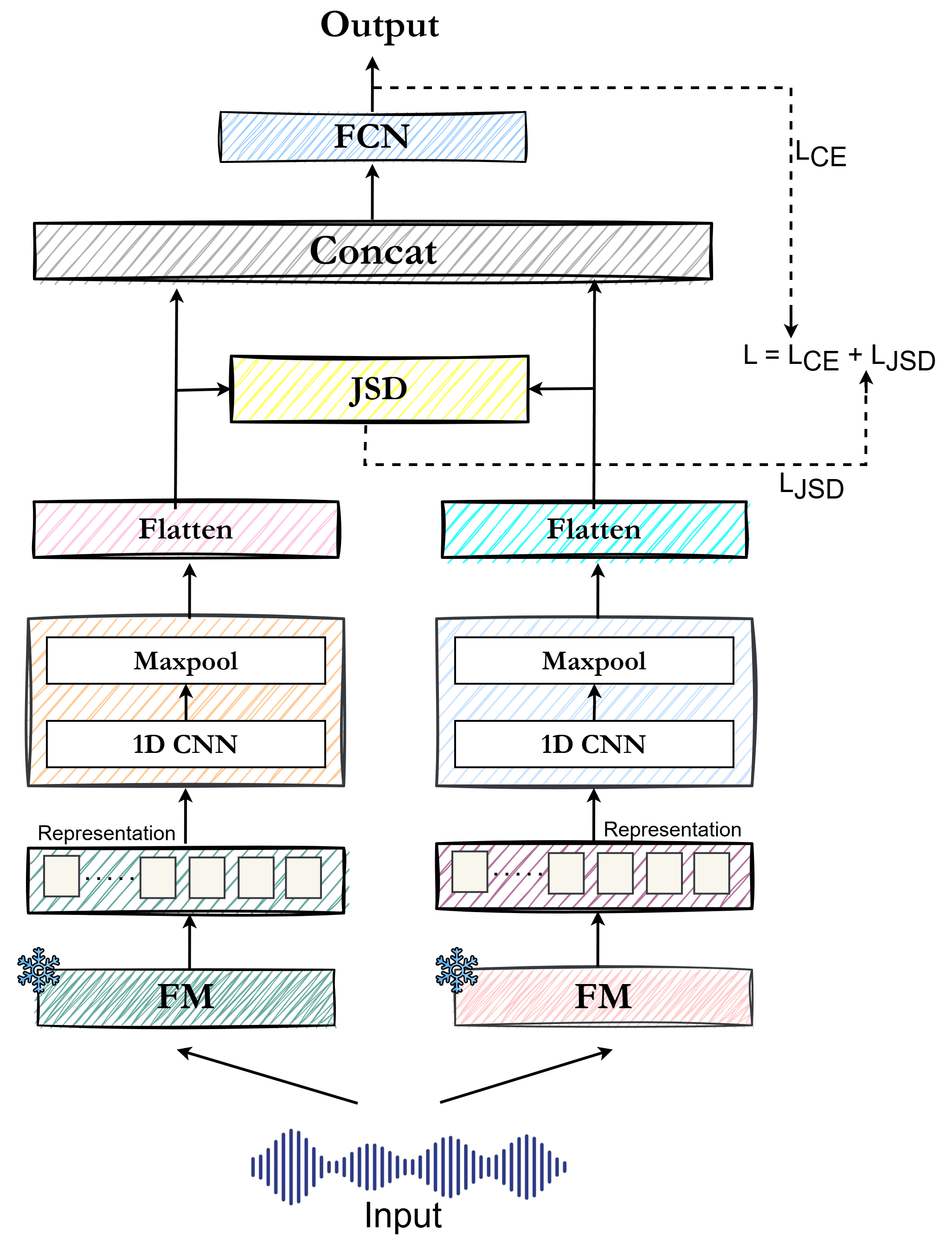
BONSAI framework diagram

Figure: The BONSAI framework. Each foundation model (FM) branch is processed by a 1D-CNN and max-pooling, flattened, and aligned via JSD before concatenation and classification.

Alignment Loss

L_JSD = (1/2) KL(p || m) + (1/2) KL(q || m), where m = (1/2)(p + q)

Training Objective

L = lambda * L_CE + (1 - lambda) * L_JSD

The classification loss L_CE and the JSD alignment loss L_JSD are jointly optimized, with lambda = 0.65 controlling the balance between the two. BONSAI has 3.8M-4.02M trainable parameters depending on the FM representation dimensionality.

Task

Elderly CodecFake Detection

Binary real-vs-spoof detection of neural-audio-codec-synthesized elderly speech.

Fusion

JSD Alignment

A novel use of Jensen-Shannon Divergence to align heterogeneous FM representation spaces.

Backbones

LanguageBind + ImageBind

Multimodal FMs whose cross-modal pretraining implicitly captures age-related cues.

Downstream

1D-CNN + FCN

Lightweight CNN and max-pooling per branch followed by a fully connected classifier.

Best Result

1.66% Avg EER

BONSAI with LanguageBind + ImageBind sets a new SOTA for the ECFD task.

Goal

Robust elderly transfer

Designed to close the cross-demographic generalization gap left by existing CF detectors.


Results

Table 1: Generalization of SOTA CF detectors to elderly speech (zero-shot)

Models trained on the prior CF benchmark (Lu et al.) generalize poorly to elderly speech. EER nearly doubles on the elderly subset of E2 (TIS) compared to the younger subset, indicating age-related degradation beyond simple distribution mismatch.

ModelE1 (SeniorTalk)E2 (TIS Corpus)
YoungElderly
AASIST30.1814.0727.45
Wav2vec2-AASIST28.3212.8925.76

EER (%, lower is better). E1: SeniorTalk, E2: TIS Corpus.


Table 2: In-domain training and evaluation on ECFD

Multimodal FMs (ImageBind, LanguageBind) consistently outperform speech-only FMs (Wav2vec2, WavLM, Whisper) under both AASIST and CNN downstream classifiers, supporting the hypothesis that cross-modal pretraining benefits ECFD.

SettingE1E2 (Elderly)Avg
AASIST (End-to-End)14.5413.6614.10
Wav2vec2 + AASIST11.7611.0211.39
WavLM + AASIST11.3410.6611.00
Whisper + AASIST10.129.869.99
ImageBind + AASIST6.535.796.16
LanguageBind + AASIST6.485.215.85
Wav2vec2 + CNN11.0210.2910.66
WavLM + CNN10.679.139.90
Whisper + CNN8.468.148.30
ImageBind + CNN5.415.265.34
LanguageBind + CNN4.814.304.56

EER (%, lower is better). Avg is the average EER across E1 and E2 (Elderly).


Table 3: BONSAI fusion vs. concatenation

BONSAI consistently outperforms simple concatenation across all FM pairs, with the largest gains for multimodal and speech+multimodal combinations. The best pair, ImageBind + LanguageBind, achieves a new SOTA average EER of 1.66%.

PairConcatenationBONSAI
E1E2 (Elderly)AvgE1E2 (Elderly)Avg
Wav2vec2 + WavLM9.369.019.187.546.977.26
Wav2vec2 + Whisper7.176.636.906.245.645.94
Wav2vec2 + ImageBind5.204.795.004.873.224.05
Wav2vec2 + LanguageBind4.474.224.354.003.763.88
WavLM + Whisper7.947.357.655.685.175.43
WavLM + ImageBind5.124.724.924.364.094.23
WavLM + LanguageBind4.864.434.653.923.563.74
Whisper + ImageBind4.514.024.273.232.953.09
Whisper + LanguageBind3.783.143.462.782.362.57
ImageBind + LanguageBind3.012.502.761.801.511.66

EER (%, lower is better). Avg is the average EER across E1 and E2 (Elderly).


Dataset and Codecs

The ECF dataset pairs authentic elderly speech with codec-resynthesized counterparts produced by 14 neural audio codec variants spanning two languages.

Chinese · Elderly Conversational

SeniorTalk (E1)

Mandarin conversational speech from super-aged seniors (75-85), 55.53 hours of spontaneous dialogue from 202 speakers across 16 provinces. 60,029 real utterances.

Source recordings
English · Mixed-Age

TIS Corpus (E2)

1,152 utterances from 96 speakers spanning younger (18-45) and older (60+) adults across White, Black, and South Asian backgrounds. 720 real elderly utterances used for ECFD.

Source recordings
8 Codec Families · 14 Variants

Neural Audio Codecs

DAC (16/24/44 kHz), EnCodec (24/48 kHz), SoundStream (16 kHz), SpeechTokenizer (16 kHz), FunCodec (16 kHz), AudioDec (28/48 kHz), SNAC (24/32/44 kHz), MIMI (24 kHz).

Codec backbones
Resulting Dataset

Elderly-CodecFake (ECF)

60,749 real elderly utterances paired with 850,486 NAC-generated counterparts across all 14 codec variants, English and Chinese.

Real + Spoof pairs

Audio Samples

Sample rows below are loaded from audio/manifest.js. Each row pairs a real elderly recording with its codec-generated counterpart.

CodecGround Truth IDGT SpeechGenerated SpeechSource

Citation

If you use the ECF dataset or BONSAI, please cite the paper as follows:

@inproceedings{ecfd-interspeech2026, title = {Bridging the Age Gap: Towards Detecting Neural Audio Codec Synthesized Elderly Speech Deepfake}, author = {Phukan, Orchid Chetia and Girish and Akhtar, Mohd Mujtaba and Lee, Chi-Chun}, booktitle = {Proceedings of Interspeech 2026}, year = {2026}, pages = {TBD}, }

Update page numbers in the citation once the proceedings version is finalized.